Artificial Intelligence is no longer a niche topic; it has become a strategic success factor for modern enterprises. The numbers speak for themselves: current studies show that 47% of German companies are evaluating AI solutions¹. However, the reality is often sobering—only one in three of these companies actually manages to deploy them into production.
What could be the problem? Often, decision-makers focus exclusively on the technical implementation of the AI itself. In doing so, they overlook a critical element: AI Lifecycle Management.
Why an Isolated Focus on Roll-out is Not Enough
A narrow focus on the initial roll-out falls short. Those who ignore the entire life cycle—from the initial idea and development to structured decommissioning—face significant risks:
- Unclear Responsibilities: Who is responsible for updating the model? Who monitors performance in a live environment?
- Security Vulnerabilities: Outdated data or unpatched systems quickly become gateways for cyberattacks.
- Compliance Violations: With the EU AI Act, transparency regarding training data and risk classification is becoming mandatory. Failing to document these can lead to heavy fines.
In contrast, a strategically planned AI lifecycle minimizes risks through clear processes, ensures compliance via end-to-end audits, and transforms AI into a scalable asset that delivers real value through continuous improvement.
Lifecycle Management as the Foundation
To understand why AI Lifecycle Management is so vital, it helps to look at the underlying concept of general Lifecycle Management (LM). In an era of increasingly complex products and IT systems, LM has become indispensable.
It describes a systematic approach to planning, controlling, and continuously improving the entire life cycle of an object—whether it’s a physical product, software, or an IT system. The goals are clear: increasing efficiency, reducing costs, ensuring quality, and minimizing risks. It is not about isolated phases, but about a holistic perspective that integrates all necessary processes, data, and technologies.
Specific Challenges for IT Systems
While these principles apply universally, the lifecycle management of IT systems requires special attention. This includes conception (requirements, architecture), maintenance (patches, optimization), and secure decommissioning (data erasure). IT systems must be monitored seamlessly, documented for audits, and designed to be scalable and resilient. In the IT world, LM is not a „nice-to-have“—it is a strategic necessity.
Deep Dive: What is AI Lifecycle Management?
AI Lifecycle Management (AI LM) applies these principles to the specific world of Artificial Intelligence. It is the systematic approach to planning, steering, and optimizing the entire life cycle of an AI model. AI LM is not an isolated tool, but a holistic strategy that connects technology, data, and operational processes.
The AI pipeline is more complex than many realize; it resembles a labyrinth of dependencies rather than a linear process. When AI projects fail, it is often due to a lack of structure. Real-world examples highlight these risks:
- Fraud Detection: A poorly trained model leads to false accusations—a disaster for a company’s reputation and legal department.
- Lending & Credit: An unmonitored model may unconsciously discriminate against certain customer groups, leading to reputational loss and regulatory fines.
- Production Control: Unpatched or outdated AI models can cause errors in manufacturing, leading to high correction costs.
To prevent this, every phase of the AI lifecycle must be thoroughly planned and documented.
The 5 Phases of the AI Lifecycle
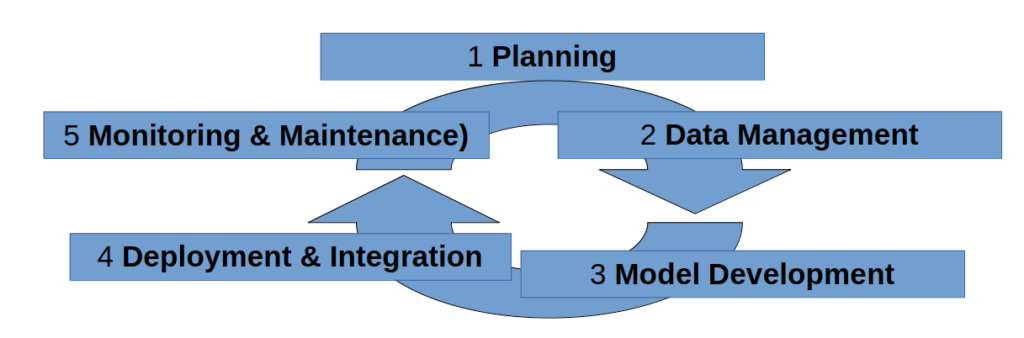
1. Planning Before a single line of code is written or data is collected, there must be clarity. What specific problem should the AI solve? How do we measure success? Are roles and responsibilities aligned across teams? Are the budget, tools, and expertise available? Without proper planning, the foundation is missing.
2. Data Management A model is only as good as its data. The goal is to provide high-quality, structured data. This involves collecting from trusted sources, preprocessing (cleaning, formatting, labeling), and rigorous versioning to avoid inconsistencies.
3. Model Development This is where the heart of the project is built. Beyond selecting the right algorithm and training/validation, the focus is on transparency and fairness. Overfitting must be avoided, and model explainability (e.g., for audits) must be ensured. Analyzing the data for bias is essential.
4. Deployment & Integration Now the model enters the real world. Decisions regarding infrastructure (Cloud, On-Premises, Hybrid) must be made, and the model must be seamlessly connected to existing apps and APIs. Utilizing CI/CD pipelines and DevOps principles (automation, versioning) reduces errors and ensures scalability.
5. Monitoring & Maintenance The work doesn’t end after the roll-out. Performance (accuracy, latency) must be continuously monitored. Since real-world data changes over time (Data Drift), regular retraining and updates are necessary. Governance aspects, such as compliance (EU AI Act, GDPR) and auditability, must be guaranteed throughout.
Conclusion
The journey from a promising AI pilot to a value-generating, productive application inevitably leads through professional AI Lifecycle Management. If you want to use AI sustainably and successfully, your vision must not end at the implementation finish line. Only a holistic view of the entire lifecycle transforms technology into a true, scalable, and secure competitive advantage. AI LM is the framework that makes innovation future-proof.
Related links:
1. https://www.bitkom.org/Presse/Presseinformation/Durchbruch-Kuenstliche-Intelligenz
2. https://www.salesforce.com/platform/ai-lifecycle-management/
3. https://www.ibm.com/de-de/think/topics/ai-lifecycle